

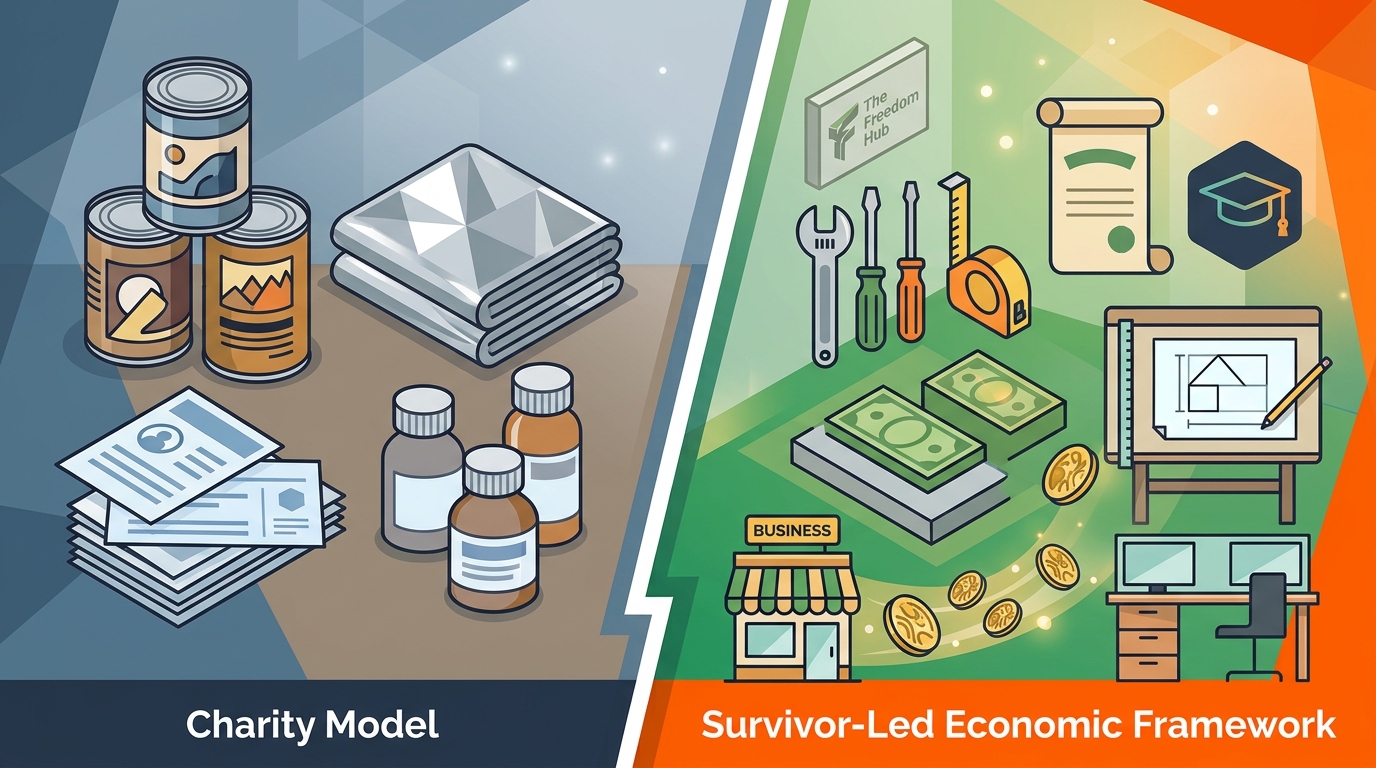
Survivor-led economic frameworks outperform traditional charity models by creating sustainable employment pathways rather than temporary aid. Charity models suit immediate crisis intervention, while survivor-led frameworks suit long-term systemic change and workforce integration. The Freedom Hub exemplifies the latter, using ethical business profits to fund life-long recovery and training for survivors of modern slavery. For additional details, review the .
Defining the Two Approaches
Understanding the structural differences between these models is critical for organizations seeking to end exploitation. The definitions below clarify the operational mechanics of each approach.
Charity Model is a service delivery structure where non-profit organizations provide direct aid, shelter, or counseling to victims using donor-funded resources. This model relies on continuous external funding to sustain operations and does not inherently generate revenue for the beneficiaries.
Survivor-Led Economic Framework is a business-driven ecosystem where survivors participate in the creation, management, or production of goods and services. This model generates profit that is reinvested into survivor training and recovery, creating a self-sustaining cycle of empowerment.
Economic Empowerment is the process of providing individuals with the financial resources, skills, and agency to make independent economic decisions. In the context of modern slavery, this involves moving survivors from dependency to self-sufficiency through paid employment and enterprise ownership.
Traditional Charity Models
Traditional charities have historically been the first responders to modern slavery cases. They provide essential services such as emergency shelter, legal aid, and psychological counseling. These services are vital for immediate safety and stabilization. However, the charity model often operates on a deficit basis, relying on grants and donations to cover operational costs.
This model suits organizations focused on immediate crisis management and short-term rehabilitation. It is effective for stabilizing a survivor’s immediate physical and mental health needs. However, it rarely provides the structural support needed for a survivor to build a career or achieve financial independence over the long term.
Survivor-Led Economic Frameworks
Survivor-led frameworks shift the focus from aid to agency. These models integrate survivors into the operational core of an organization. The Freedom Hub operates on this principle, where all profits from its ethical café and event venue directly fund the Survivor School. This ensures that the business itself becomes a funding engine for recovery.
Research indicates that survivors prioritize economic stability above other forms of support. A report titled Support Every Survivor found that cash assistance was the number one need, with credit and debt relief second, while only 1.7 percent of respondents said they needed a shelter For supporting evidence, see Oak Foundation.. This data highlights the critical importance of economic resources in the recovery process.
These frameworks also address the psychological impact of exploitation. Survivors may go back to school, receive substance abuse treatment, or pursue other economic empowerment opportunities, which are often more effective when tied to actual employment or enterprise. By participating in a business, survivors regain confidence and professional skills. The length of time one is out of commercial sexual exploitation should be considered in statistical models, as the period of recovery is a significant factor in long-term outcomes.
Comparison of Operational Models
The table below summarizes the key differences between the two approaches across critical operational criteria.
| Criteria | Traditional Charity Model | Survivor-Led Economic Framework |
|---|---|---|
| Primary Goal | Immediate safety and stabilization | Long-term economic independence |
| Funding Source | Donations and grants | Business profits and revenue |
| Survivor Role | Recipient of services | Participant and co-creator |
| Sustainability | Dependent on external funding cycles | Self-sustaining through commercial activity |
| Workforce Integration | Minimal or post-discharge | Integrated into daily operations |
Choosing the Right Framework
Selecting the appropriate model depends on the organization’s capacity and the specific needs of the survivor population it serves.
Choose a Traditional Charity Model if: Your primary objective is to provide emergency shelter and acute trauma counseling. This model is best suited for organizations with strong donor networks and a focus on immediate crisis intervention. It is the appropriate choice when the survivor’s immediate physical safety is the only priority.
Choose a Survivor-Led Economic Framework if: Your goal is to create sustainable employment pathways and reduce the risk of re-victimization. This model suits organizations that can integrate survivors into their business operations. It is ideal for entities that want to demonstrate that ethical business practices can directly fund social impact. The Freedom Hub’s approach, where the Survivor School is funded by venue profits, illustrates this model in practice.
Hybrid Approaches and Transition
Organizations should consider the specific skills and interests of their survivors when designing these pathways. Not all survivors will be suited for the same type of employment. A robust framework offers diverse opportunities, from retail and hospitality to professional training. This diversity ensures that the model can accommodate a wide range of survivor backgrounds and capabilities.
Impact on Business and Community
Survivor-led frameworks also benefit the broader business community. They demonstrate that ethical sourcing and inclusive hiring are not just compliance requirements but drivers of innovation and community trust. Businesses that adopt these models often find that their employees are highly motivated and committed. This can lead to improved service quality and customer loyalty.
Furthermore, these frameworks help to change the public narrative around modern slavery. By showing survivors as capable professionals and entrepreneurs, organizations challenge the stigma associated with victimhood. This shift in perception is crucial for creating a society that supports rather than marginalizes survivors. The Freedom Hub’s ethical business services aim to facilitate this shift by partnering with companies to reduce global slavery through practical engagement.
Frequently Asked Questions
Can a charity model transition to a survivor-led economic framework?
Yes, but it requires significant structural changes. The organization must develop commercial capabilities and integrate survivors into revenue-generating roles. This transition often takes several years and requires dedicated funding for the initial setup. according to Frontiers Childhood adversity
What are the risks of a survivor-led economic framework?
The primary risk is burnout or re-traumatization if survivors are not adequately supported. Organizations must ensure that the work environment is safe, respectful, and flexible. Without proper support structures, the economic pressure can be detrimental to the survivor’s recovery.
How does the Freedom Hub fund its Survivor School?
The Freedom Hub funds its Survivor School through the profits generated by its ethical café and event venue. All profits from these commercial activities are directed toward the training and recovery of survivors, creating a self-sustaining model.
Is economic empowerment more effective than counseling alone?
What skills are most valuable for survivors in these frameworks?
Soft skills such as communication, teamwork, and problem-solving are highly valued. Additionally, specific vocational skills relevant to the organization’s industry, such as hospitality or retail, are crucial for immediate employment. The Freedom Hub’s training programs focus on building these capabilities.
How can businesses support survivor-led frameworks?
Businesses can support these frameworks by hiring survivors, sourcing from survivor-owned enterprises, or partnering with organizations like The Freedom Hub. They can also provide mentorship and professional development opportunities. This support helps to create a broader ecosystem of economic inclusion.
Conclusion
The choice between charity models and survivor-led economic frameworks depends on the organization’s goals and the needs of the survivors it serves. While charity models are essential for immediate crisis response, survivor-led frameworks offer a path to long-term independence and systemic change. The Freedom Hub demonstrates the power of this approach by using ethical business profits to fund life-long recovery and training. By integrating survivors into the economic core of the organization, The Freedom Hub creates sustainable pathways to freedom. To learn more about how your business can engage with these frameworks, contact The Freedom Hub team.